
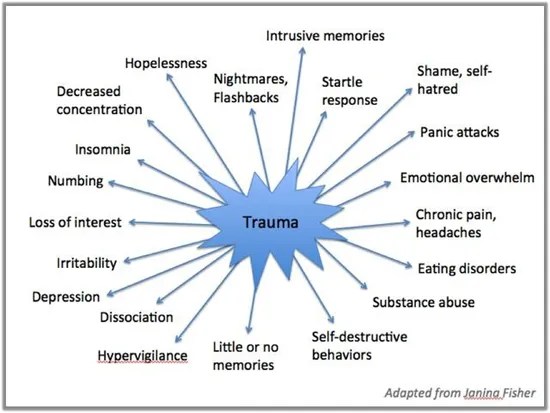
Trauma isn’t always easy to get over. People handle things in different way, so when you tell someone “You need to let that go,” think about how long they fought through it while it has happening, or still being in the area it happened in. You can’t say you understand, because you’re not that person. Not everyone is immuned to the same conditions, people were raised differently, born differently, handled differently, so adjusting to new circumstances that caused trauma is always going to be hard. You see, when you grow up in those circumstances it’s easy for YOU to handle it because you are immuned to that, when a person is taken out of their comfort zone, or peace that they are used to, and thrown into something that’s the complete opposite, it can have long term effects. We don’t blame the person for what they feel, how they feel, or how they handle it. The best thing we can do is be as supportive as we can. That means having patience, giving reassurance, noticing when a person is trying. That person can be an adult or child. Just because you say “F it,” and move forward does not mean anyone else can.
The thing we fail to realize the most is that everyone wasn’t built the same. Constant acknowledgment of letting go of trauma can cause disagreements, or hurt when you don’t fully understand the person’s background and where they’ve come from to where they are going. It is very important that we listen to one another, especially when discussing trauma. That helps a lot, all people want to do is to be heard and UNDERSTOOD. You see the difference between adults, and children is that adults can hide those things behind a smile, a child cannot. They are human too and carry emotions, but may not know how to express them. When they feel unheard or misunderstood, they act out, this also includes not knowing how to express themselves. Acting out seems to be the only way to express themselves because they are children, they have nothing else to turn too, and yes, acting out can happen during play. The best way to tame that is to sit and learn, and understand their emotions, and why they feel the way they do. When they feel understood, is when they feel protected. Not feeling protected or understood can lead to other things that we do not wish upon children. I guess that’s what also gravitates me to children because everything starts at aa young age, and at home. The faster you get a hold of it, the stronger the relationship becomes, and it also makes it easier for teachers.
As a prior pre-school teacher, I have seen children act out for many reasons that all start from home. I’ve even had parents commend me telling me that the things I’ve had their children doing in school, they wouldn’t attempt to do at home. All it took was a simple way of finding out ways they are comfortable with interacting, in order to get through them. I had a child of whom will remain anonymous, but he didn’t talk for months in school, and at home. I found out something he liked which was lego’s, and started doing one on one conversations and sit downs with the Lego’s. He eventually felt comfortable, and safe enough to open up and be himself knowing that he can talk to Ms.Jessica about anything started to make him more vocal with his friends. He then started playing, and was caught by his parents who were shocked to see him opening up in school. We then kept that same school-home relationship. Which means what I practiced with him in school, they started doing at home as they had already noticed he loved legos. Sometimes all it takes is a little extra harder push, and gentle support. You cannot rush anything with children.


Leave a Reply